







.webp)
.webp)
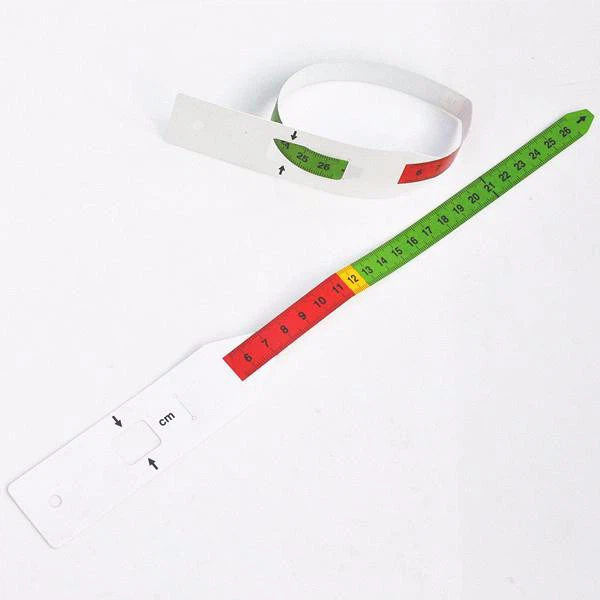
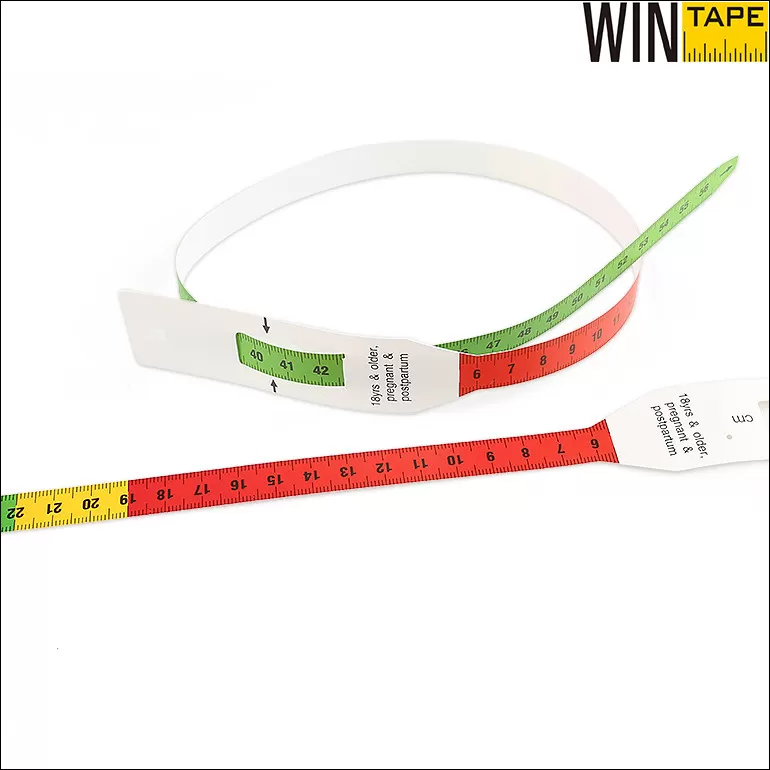
Mid-Upper Arm Circumference (MUAC) tape is a simple but vital tool used primarily to screen for malnutrition by measuring the circumference of the upper arm. It is widely employed for children aged 6–59 months and pregnant or lactating women, especially in resource-limited settings where more complex nutritional assessment tools may not be available. By providing a quick, non-invasive, and reliable method to identify acute malnutrition, MUAC tape enables early intervention, which can be life-saving. Its application is critical in humanitarian crises, community health programs, and clinical settings for monitoring nutritional status.
The tape often comes with color-coded segments that simplify interpretation:
🟥 Red indicates severe acute malnutrition.
🟨 Yellow suggests moderate acute malnutrition.
🟩 Green signifies a normal nutritional status.
This color-coding allows even community health workers and caregivers with minimal training to effectively identify at-risk individuals.
What Is the Normal Range of MUAC Tape?
MUAC tapes are designed differently for various populations, primarily children and adults (especially pregnant or lactating women). The ranges and color codes differ based on the target group, and it's crucial to use the appropriate tape for accurate screening.
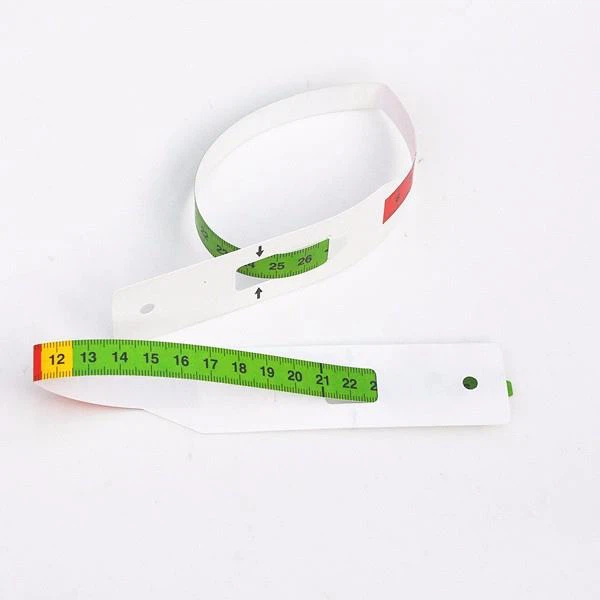
For Children (Up to 26 cm Range)
MUAC tape for children is typically color-coded and has a measuring range of up to 26 centimeters. The World Health Organization (WHO) and other health bodies provide standard cut-offs, though recent research suggests these may need adjustment for specific populations, such as children with cerebral palsy.
Here’s a general guideline:
| Color Zone | MUAC Range (cm) | Nutritional Status |
|---|---|---|
| 🟥 Red | 5.5 – 11.5 | Severe acute malnutrition |
| 🟨 Yellow | 11.5 – 12.5 | Moderate acute malnutrition |
| 🟩 Green | 12.5 – 26.5 | Normal nutrition |
However, a 2025 multi-center study focusing on preschoolers with cerebral palsy (CP) found that WHO cut-offs had high specificity but low sensitivity for this group. They proposed new, higher cut-offs for children with CP:
Mild malnutrition: ≤15.35 cm
Moderate malnutrition: ≤15.05 cm
Severe malnutrition: ≤14.35 cm
Overweight: ≥17.55 cm
Obesity: ≥20.4 cm
This highlights the importance of population-specific adjustments for accurate screening.
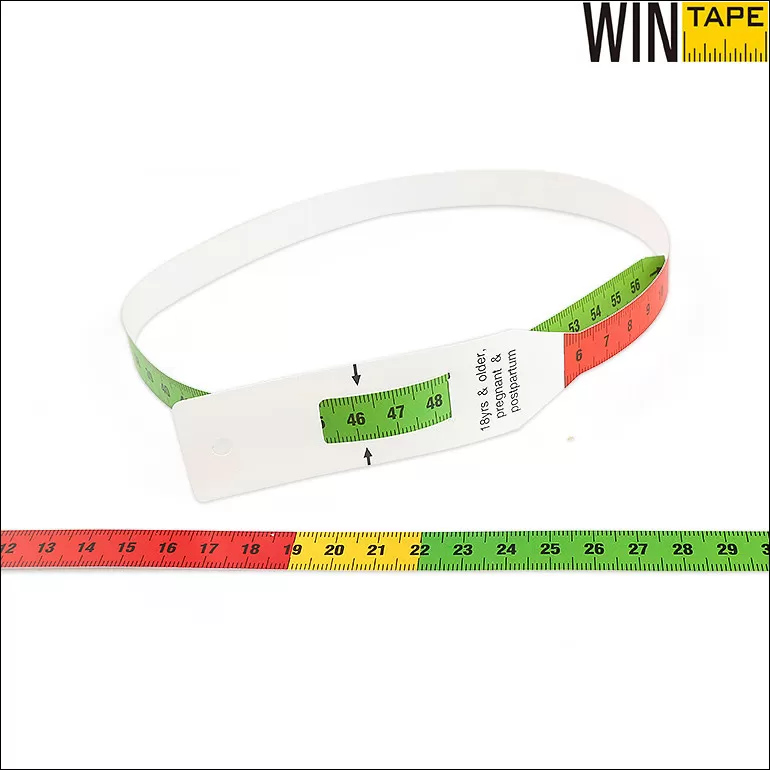
For Adults (Up to 56 cm Range)
MUAC tape for adults, often used for rapid screening of pregnant and lactating women, has a larger range, typically up to 56 cm. The interpretation is as follows:
| Color Zone | MUAC Range (cm) | Nutritional Status |
|---|---|---|
| 🟥 Red | 5.5 – 19.0 | Severe acute malnutrition |
| 🟨 Yellow | 19.0 – 22.0 | Moderate acute malnutrition |
| 🟩 Green | 22.0 – 56.5 | Normal nutrition |
Studies have shown that MUAC can be a valuable tool for identifying maternal acute malnutrition. One study noted that using MUAC (with cut-offs of <23 cm for thinness and <21 cm for severe thinness) identified a higher proportion of malnourished women compared to Body Mass Index (BMI).
How to Use MUAC Tape: A Step-by-Step Guide
Using MUAC tape correctly is essential for obtaining accurate and reliable measurements. The procedure is straightforward and can be performed by healthcare workers, community volunteers, or even trained caregivers.
Step-by-Step Measurement Procedure
1.Locate the Landmarks: Identify the two key bony landmarks on the left upper arm:
- The acromion (the bony tip of the shoulder).
- The olecranon process (the bony point of the elbow).
2. Find the Midpoint:
Bend the subject's left arm at a 90-degree angle, creating a right angle at the elbow.
Measure the distance from the acromion to the olecranon process using a flexible measuring tape.
Calculate the midpoint of this length and mark it on the arm with a pen.
Pro Tip (String Method): If a tape isn't available, use a piece of string. Place it from the shoulder to the elbow, fold it in half to find the midpoint, and then mark the arm.
3. Position the Arm: Have the person relax their arm completely. It should hang loosely and naturally at their side. Ensure the arm is bare at the midpoint area.
4. Apply the MUAC Tape:
- Take the MUAC tape and place the zero-end at the marked midpoint.
- Gwrap the tape around the arm at this exact level, ensuring it is snug but not tight. The tape should contact the skin around the entire arm without compressing it.
5. Ensure Proper Tension: Pull the tail of the tape through the slit or window to create a loop. Check that the tape is lying flat against the skin and is not twisted.
6. Read the Measurement: Look at the number where the zero-end meets the tape. Read the measurement to the nearest millimeter (mm) or 0.1 centimeter (cm).
7. Record the Measurement Immediately: Document the reading right away to avoid forgetting or mixing up numbers. Compare the measurement to the color zones or standard cut-offs to determine the nutritional status.
Wintape Provides Custom MUAC Tape Services
Benefits of Custom MUAC Tapes
- Branding and Trust: Custom printed logos, slogans, or organization names on the tapes increase brand visibility and foster trust within communities.
- Tailored Guidelines: While standard color codes are common, you can incorporate specific instructional text or population-specific cut-off values directly on the tape to minimize interpretation errors. This is especially useful for programs targeting unique demographics, like children with disabilities.
- Durability and Quality: Wintape's MUAC tapes are typically made from environmentally friendly polypropylene (PP), which is anti-stretch and durable, ensuring measurements remain accurate even with frequent use in harsh field conditions.










Wintape Measuring Tape Company
Custom Tape Measure Manufacturers
For All Your Measuring and Promotional Needs.
86-18588000509
cici@tape-measure.com
Custom Tailor Measuring Tape
Custom Body Measuring Tape
Custom Paper Measuring Tape
Custom MUAC Tape
Custom Wound Ruler
Custom Diameter Pi Tape
Custom Digital Tape Measure Laser
Custom Adhesive Measuring Tape
Custom Mini Tape Measure
Custom Horse Weight Tape
Custom Stainless Steel Tape Measure
Custom Long Tape Measure
Custom Measuring Tape
© 2025 Wintape Tape Measure Co.,Ltd | Privacy Policy | Sitemap | Contact Us | Powered by matchPages